Peanut Butter Skillet Cookie with Reeses | Molten Finish

- Effort/Time: 35 minutes total (Low effort, high impact).
- Flavor Hook: Salty-sweet peanut butter base with shattered chocolate-shell bursts.
- Perfect for: Impressing a crowd or a decadent weeknight "pizookie" craving.
- Creating the Ultimate Peanut Butter Skillet Cookie with Reeses
- Why This Recipe Works
- Precision Engineering for the Perfect Large Format Dessert
- The Molecular Structure of Fats and Sugars
- Essential Tools for Thermal Conductivity and Depth
- Mastering the Emulsion and Maillard Reactions
- Why Your Large Format Cookies Sink or Crumble
- Texture Modifications and Alternative Fat Profiles
- Preserving the Crumb Structure and Moisture Levels
- Temperature Contrast and Flavor Pairing Protocols
- Recipe FAQs
- 📝 Recipe Card
Creating the Ultimate Peanut Butter Skillet Cookie with Reeses
We have all been there: you pull a cookie from the oven only to have it crumble into dry, sandy dust the moment it hits your tongue. It is the ultimate kitchen heartbreak. I used to think the "skillet" part was just for show a rustic aesthetic for the 'gram until I realized I was treating the cast iron like a regular baking sheet.
My first three attempts were essentially peanut flavored hockey pucks because I didn't account for the residual heat.
I ruined those batches so you don't have to. I overbaked them, used cold eggs that broke my emulsion, and forgot that peanut butter adds a massive amount of fat that behaves differently than butter alone.
I was looking for a velvety, molten interior with a shattered glass crisp on the edges, but I kept getting "bread like" sadness.
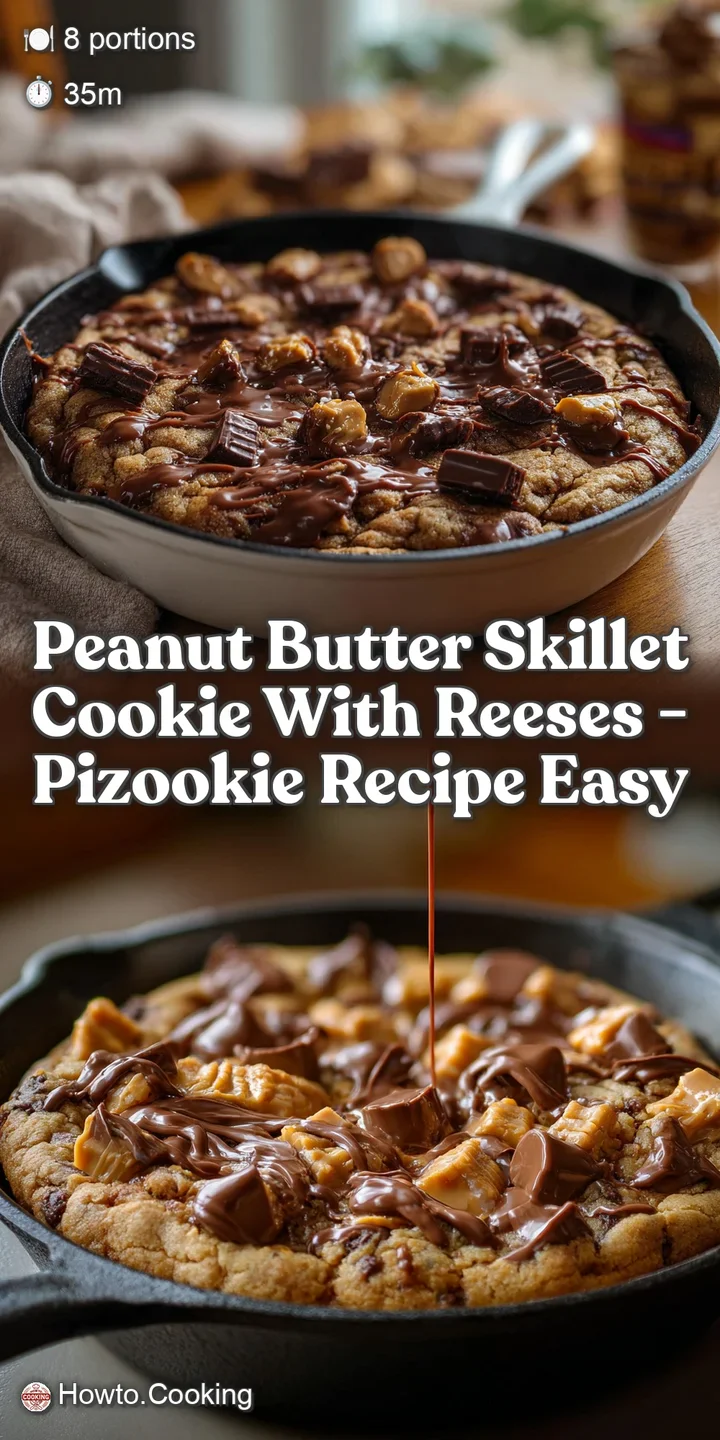
The secret to a Masterclass level Peanut Butter Skillet Cookie with Reeses lies in the physics of thermal retention. By using a heavy skillet, we create a heat soak environment that cooks the edges into a mahogany crust while the center remains in a state of soft, gelatinized bliss.
This isn't just a big cookie; it's an engineered dessert designed for maximum Maillard reaction and moisture lock.
Why This Recipe Works
- Residual Heat Equilibrium: The cast iron skillet acts as a thermal battery, continuing to cook the dough even after it leaves the 350°F environment, ensuring the center sets without drying out.
- Emulsion Stability: Using a room temperature egg allows the lecithin to bond the water in the whites to the high fat content of the 130g Creamy Peanut Butter, preventing a greasy, separated crumb.
- Hygroscopic Synergy: The 100g of Light brown sugar contains molasses, which attracts and holds water molecules more effectively than granulated sugar, keeping the interior soft for days.
- Starch Gelatinization Control: By precisely measuring 190g of All-purpose flour, we provide just enough structure to hold the fats without creating a tough, bready texture.
Precision Engineering for the Perfect Large Format Dessert
| Specification | Metric Value | Human Readable Format |
|---|---|---|
| Preparation Time | 15 Minutes | 15 minutes |
| Thermal Processing Time | 20 Minutes | 20 minutes |
| Total Throughput | 35 Minutes | 35 minutes |
| Output Yield | 8 Portions | 8 servings |
| Energy Density | 510 kcal | 510 calories per serving |
The Molecular Structure of Fats and Sugars
| Ingredient | Chemical/Physical Role (Science) | The Pro Secret (Why This Matters) |
|---|---|---|
| Creamy Peanut Butter | High lipid-to-protein ratio for tenderization | Interrupts gluten strands for a "melt-in-mouth" texture. |
| Light Brown Sugar | Glucose + Fructose + Molasses (Hygroscopy) | Creates the "chew" by pulling moisture from the air. |
| Baking Soda | Chemical leavening via CO2 release | Reacts with acidic brown sugar to provide lift and browning. |
| Large Egg | Protein denaturation & Emulsification | Provides the structural "scaffold" that prevents the cookie from collapsing. |
Selecting Your Elements
- 1/2 cup (113g) Unsalted butter: Why this? Controls sodium levels while providing the 80% milkfat needed for flavor.
- 1/2 cup (130g) Creamy Peanut Butter: Why this? Adds non-dairy fats that stay liquid at room temp for softness.
- 1/2 cup (100g) Light brown sugar: Why this? Acidic pH triggers the baking soda for a better rise.
- 1/4 cup (50g) Granulated white sugar: Why this? Encourages surface evaporation for a crisp exterior crust.
- 1 Large egg, room temperature: Essential for a smooth batter.
- 1 tsp (5ml) Pure vanilla extract: Enhances the aromatic profile.
- 1 1/2 cups (190g) All-purpose flour: The structural backbone.
- 3/4 tsp Baking soda: The primary lift agent.
- 1/2 tsp Sea salt: Contrast to the heavy sugar load.
- 3/4 cup (150g) Reese’s Pieces candies: Divided for texture.
- 1/2 cup (85g) Semi sweet chocolate chips: Adds dark cocoa notes to balance the peanut.
Essential Tools for Thermal Conductivity and Depth
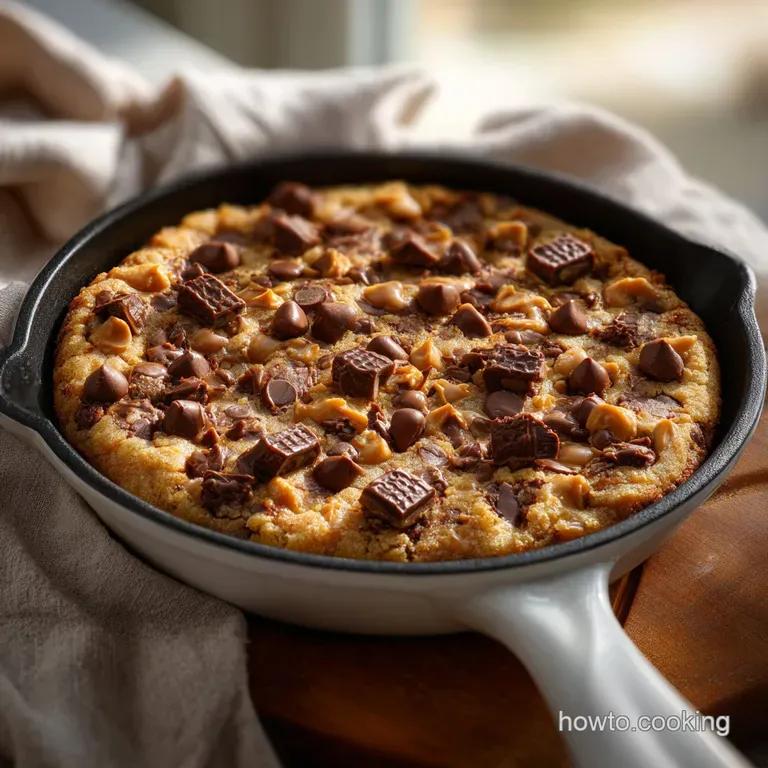
To make this Peanut Butter Skillet Cookie with Reeses properly, you need a Lodge 10.25 inch Cast Iron Skillet. A standard cake pan won't work because it lacks the mass to hold heat.
You will also want a KitchenAid Hand Mixer or a sturdy whisk to ensure the creaming process effectively aerates the fats.
For ingredient precision, use a Greater Goods Digital Food Scale. Volumetric cups are notorious for "packing" flour, which leads to dry cookies. If you're serious about your Peanut Butter Cookies recipe, weight is the only way to go.
Mastering the Emulsion and Maillard Reactions
- Preheat oven to 350°F (175°C). Wait until the thermostat clicks to ensure even heat.
- Cream 113g Unsalted butter, 130g Creamy Peanut Butter, 100g Light brown sugar, and 50g granulated sugar for 3 minutes until the mixture turns pale and fluffy.Note: This incorporates air pockets for a lighter crumb.
- Incorporate the room temperature egg and 5ml vanilla extract until the mixture is glossy and smooth.Note: This creates the primary emulsion.
- Whisk 190g flour, 3/4 tsp baking soda, and 1/2 tsp sea salt in a separate bowl until no clumps of soda remain.
- Fold the dry ingredients into the wet until just combined and no white streaks of flour are visible.Note: Over mixing develops gluten, making the cookie tough.
- Stir in 1/2 cup of the Reese’s Pieces and all 85g chocolate chips until evenly distributed throughout the thick dough.
- Press the dough into a 10 inch Lodge Cast Iron Skillet until it reaches the edges in an even layer.
- Top with the remaining Reese’s Pieces until the surface is studded with color.
- Bake for 18 20 minutes until the edges are a deep mahogany brown and the center still jiggles slightly.
- Rest in the skillet for 10 minutes until the residual heat finishes the center and the sizzle subsides.
Chef's Tip: Sprinkle a tiny pinch of espresso powder or extra sea salt on top before baking. The bitterness of the coffee or the sharpness of the salt acts as a "flavor bridge" between the heavy fats and the sugar, preventing flavor fatigue.
Why Your Large Format Cookies Sink or Crumble
The Science of Why Cookies Stay Crispy
If your Peanut Butter Skillet Cookie with Reeses is turning out greasy or flat, it's likely a temperature failure. When fats melt before the flour proteins (gluten) have a chance to set, the structure collapses. This is common if your butter was "greasy soft" rather than "pliable soft."
| Problem | Root Cause | The Fix | Pro Protocol |
|---|---|---|---|
| Greasy surface | Butter was too warm | Use cool room-temp butter (65°F) | Chill dough for 15 mins in the skillet before baking |
| Crumbly texture | Over measured flour | Use a digital scale (190g) | Never scoop directly with the cup; spoon and level |
| Raw center | Skillet wasn't preheated | Start with a room temp skillet | Check internal temp; 175°F-185°F is the sweet spot |
Why Your Center is Sinking
A sinking center in a Cookie with Reeses Pieces usually points to over creaming. If you whip too much air into the dough, it rises like a soufflé in the oven and then undergoes a structural "implosion" once it hits cool air. Mix on medium speed, never high.
Texture Modifications and Alternative Fat Profiles
| Original Ingredient | Substitute | Why It Works |
|---|---|---|
| Unsalted Butter | Salted Butter | Adds savory depth; omit the 1/2 tsp sea salt from recipe. |
| All-purpose flour | 1:1 gluten-free Flour | Works well; results in a slightly grittier, but still delicious, texture. |
| Semi sweet Chips | Milk Chocolate Chips | Increases sweetness; Note: May make the dish overly sugary for some. |
For a twist, you could even use the technique from my Instant milk to heavy cream guide to create a quick vanilla cream to pour over the hot cookie.
Preserving the Crumb Structure and Moisture Levels
Yes, a Peanut Butter Skillet Cookie with Reeses stays fresh for up to 4 days when covered tightly with foil at room temperature. The high fat content from the peanut butter acts as a natural preservative, slowing down the staling process (starch retrogradation).
- Fridge: Store for 1 week. Note: The fats will solidify, so it will become firm and fudge like.
- Freezer: Wrap individual wedges in plastic and freeze for 3 months.
- Reheating: Use a microwave for 15 20 seconds for a "molten" effect, or a 300°F oven for 5 minutes to restore the edge crispness.
Zero Waste Philosophy
Don't discard the Reese's Pieces "dust" at the bottom of the bag. Transform: Fold those tiny broken bits into the dough. Science: These smaller particles melt into the batter more quickly, creating "pockets" of concentrated peanut oil and sugar.
Temperature Contrast and Flavor Pairing Protocols
When scaling this Skillet Cookie with Reeses Pieces, remember the Thermal Mass Warning. If you decide to double the recipe to make two skillets, do not crowd your oven. Two heavy cast iron pans will drop the oven temperature by 20 30 degrees instantly.
You'll need to add about 5 minutes to the total bake time to compensate for the heat loss.
- 1. Salt
- If doubling, use 3/4 tsp (1.5x) instead of 1 tsp. Salt intensity accumulates non-linearly in dense doughs.
- 2. Leavening
- Keep the baking soda ratio exact. Chemical reactions don't follow the "less is more" rule.
- 3. Surface Area
- A 12 inch skillet requires 1.5x the dough to maintain the same thickness.
Myth: "You must use natural peanut butter for the best flavor." Truth: False. Natural peanut butter (oil-on-top) is too unstable for baking. The oils separate during the bake, leading to a greasy mess. Use a stabilized brand like Jif or Skippy for the perfect emulsion.
Myth: "The cookie is done when the toothpick comes out clean." Truth: If the toothpick is clean, you've overbaked it. Because of the cast iron's heat retention, you want a few moist crumbs. It will continue to firm up for 10 minutes on the counter.
For a true "Masterclass" finish, serve this Skillet Cookie with Reeses Pieces with a scoop of cold vanilla bean ice cream. The thermal contrast between the 180°F cookie and 32°F ice cream creates a sensory "shock" that highlights the richness of the fats. If you're feeling adventurous, a side of my Buffalo Sauce Recipe might be a bit too far, but a glass of cold milk is the perfect scientific palate cleanser to strip the peanut oils from your tongue between bites.
This Peanut Butter Skillet Cookie with Reeses is the ultimate marriage of culinary physics and nostalgic flavor. Enjoy the sizzle.
Recipe FAQs
Can I substitute crunchy peanut butter for creamy?
Yes, but texture will change. Crunchy nuts introduce uneven pockets of fat distribution, increasing spread slightly during baking. If you enjoyed mastering temperature precision for the molten center here, applying that same careful timing is crucial when using crunchy PB.
What prevents the edges from becoming rock hard?
The cast iron retains residual heat effectively. The high thermal mass of the iron continues cooking the cookie after removal, creating carryover steam that keeps the internal crumb moist. This contrasts sharply with thin metal pans which cool too rapidly.
Do I need to chill the dough first?
No, chilling is counterproductive here. Chilling solidifies the high fat peanut butter, preventing the dough from melting rapidly and evenly into the skillet base upon oven entry. This recipe relies on immediate melting for its signature fudgy texture.
Is it possible to bake this in a regular metal pan?
It requires significant temperature adjustment. Traditional pans lack the heat retention necessary to achieve the signature fudgy bottom layer. If you are attempting alternative baking methods, consider the techniques used for even heat distribution in our Apple Pie: The Classic Homemade Recipe with a Guaranteed Flaky Crust.
Myth: I must use room temperature butter for the best texture.
Myth: Room temperature butter is always necessary for cookies. Reality: For skillet cookies, slightly softened (not melted) butter ensures the peanut butter is fully incorporated without introducing excess air, which prevents the dense, fudgy final product.
What is the science behind the molten center?
The skillet core maintains higher internal temperature post bake. The cast iron acts as a massive heat sink, slowing the cooling process of the cookie’s center mass significantly more than the edges. This allows the center proteins and sugars to remain semi liquid past traditional doneness cues.
Can I reduce the sugar content in this recipe?
No, sugar is crucial for moisture retention. Sugar dissolves to create syrup during baking, directly influencing the final tenderness and moisture level of the crumb structure. Reducing it jeopardizes the fudgy goal, much like reducing acid compromises the tartness of our Cranberry Sauce Recipe with Orange Homemade Classic Sauce.
Peanut Butter Reeses Skillet Cookie
Ingredients:
Instructions:
Nutrition Facts:
| Calories | 510 kcal |
|---|---|
| Protein | 8.8g |
| Fat | 27g |
| Carbs | 58g |
| Fiber | 3.1g |
| Sugar | 36g |
| Sodium | 350mg |
