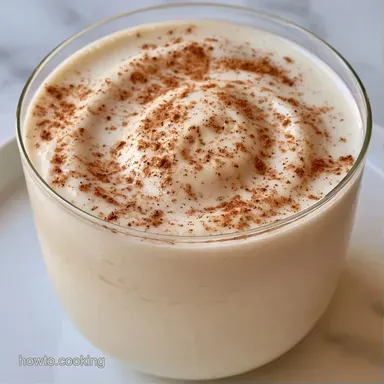
Homemade Eggnog with Cooked Custard

- Total2 Hrs 25 Mins
- Servings4
- Calories432 kcal
- Time: 15 min active + 10 min cooking + 2 hours chilling
- Texture: Thick, smooth, and rich
- Serve with: A sprinkle of fresh nutmeg or a side of shortbread
Creamy Homemade Eggnog
Ever wonder why store-bought versions taste like thin, sweetened milk? It is usually because they skip the actual cooking process. A real custard base creates a depth of flavor and a weight on the tongue that you just cannot get from a carton.
Making homemade eggnog is simpler than it looks. You just need a few basic ingredients and a bit of patience while it chills.
You can expect a drink that feels lush and tastes like the holidays. It is a great way to bring a classic touch to your gathering without needing a lot of fancy gear.
What Makes This So Good
- Controlled Tempering: Adding hot dairy to the yolks slowly prevents the eggs from scrambling, keeping the drink smooth.
- Dairy Balance: Using both whole milk and heavy cream ensures it is rich but still pourable.
Ingredient Deep Dive
| Component | Purpose | Substitute Notes |
|---|---|---|
| Egg Yolks | Thickening and richness | Use pasteurized eggs to lower risk |
| Heavy Cream | Mouthfeel and body | Half and half works but is thinner |
| Nutmeg | Signature aroma | Freshly grated is more potent |
Ingredients and Swaps
- 4 large egg yolks Why this? Provides the essential structure and richness
- 1/2 cup (100 g) granulated sugar Why this? Balances the dairy and spices
- 2 cups (480 ml) whole milk Why this? Keeps the drink from feeling too heavy
- 1 cup (240 ml) heavy cream Why this? Adds a creamy, thick consistency
- 1 tsp (5 ml) vanilla extract Why this? Adds aromatic warmth
- 1/4 tsp (1 g) ground nutmeg Why this? The classic holiday flavor
- 1/8 tsp (0.5 g) ground cinnamon Why this? Adds a subtle woody spice
- 1 pinch (0.5 g) salt Why this? Sharpens the other flavors
How to Make It
Whisking the Base
In a large mixing bowl, combine the 4 large egg yolks and 1/2 cup (100 g) granulated sugar. Whisk vigorously until the mixture becomes pale yellow and slightly thickened.

Simmering the Dairy
Pour the 2 cups (480 ml) whole milk, 1 cup (240 ml) heavy cream, 1/8 tsp (0.5 g) ground cinnamon, and 1/4 tsp (1 g) ground nutmeg into a medium saucepan. Heat over medium heat, stirring occasionally, until the liquid is steaming and small bubbles form around the edges.
Do not let it reach a rolling boil.
Tempering the Eggs
Slowly pour about 1/2 cup (120 ml) of the hot dairy mixture into the egg yolks in a thin, steady stream. Whisk constantly to temper the eggs. Note: This prevents the eggs from shocking and clumping.
Thickening the Mixture
Pour the tempered egg mixture back into the saucepan with the remaining dairy. Reduce heat to low and stir constantly for 3-5 minutes until the liquid thickens enough to coat the back of a spoon and reaches an internal temperature of 160°F (71°C).

Final Touch
Remove from heat and stir in the 1 tsp (5 ml) vanilla extract and 1 pinch (0.5 g) salt.
Cooling and Straining
Immediately pour the liquid through a fine-mesh strainer into a clean bowl to remove any small cooked egg bits.

Chilling
Place the bowl in the refrigerator and chill for at least 2 hours before serving.
Avoiding Common Pitfalls
Small egg clumps are common if the heat was excessive or the tempering process was rushed. To fix this, simply pour the mixture through a strainer, or use an immersion blender to quickly regain a velvety smoothness.
If the consistency is too thin, the liquid likely didn't hit 160°F (71°C). You can gently warm it again on low heat, but watch it closely so you don't overcook the mixture into a sweet omelet.
Fixing Lumpy Curds
Tiny bits of scrambled egg occur when the eggs cook too rapidly. Your best solution is to strain the liquid.
Handling Thin Consistency
This occurs when the custard fails to thicken. A thermometer is essential for precision.
Stopping Overheating
Immediately pull the pot off the heat and whisk in a bit of cold milk if the liquid begins to bubble aggressively.
| Problem | Root Cause | Solution |
|---|---|---|
| Grainy texture | High heat caused the eggs to curdle | Strain through fine-mesh sieve |
| Too thin | Failed to reach 160°F (71°C) | Gently reheat while stirring |
| Dull flavor | Spices didn't bloom | Add a pinch more nutmeg after chilling |
Dietary Adaptations

For a dairy-free version, you can swap the milk and cream for full-fat coconut milk and coconut cream. It will have a slight coconut flavor, but the thickness remains similar. This easy eggnog recipe also works well with maple syrup instead of sugar for a deeper, woodsy taste.
If you are serving this as part of a holiday brunch, it pairs beautifully with a slice of Cranberry Loaf recipe.
Since the egg yolks are cooked to 160°F (71°C), this version is safer for those avoiding raw eggs. For even more caution, you can use pasteurized eggs from the start.
Maple Cinnamon
Replace the granulated sugar with 1/2 cup of pure maple syrup. Reduce the vanilla slightly to let the maple shine.
Almond Vanilla
Add 1/4 tsp of almond extract along with the vanilla for a nuttier, more complex profile.
Coconut Cream
Use coconut cream and unsweetened almond milk. Note that this changes the flavor profile to something more tropical.
Common Misconceptions
Some believe that you have to whisk by hand for an hour to get the right thickness. That is not true. The thickness comes from the egg proteins coagulation at 160°F, not from the amount of whisking.
Others think that simmering the dairy for a long time improves the flavor. In reality, boiling the milk can cause it to scorch or separate, which ruins the creamy eggnog experience. Keep the heat medium-low and stop as soon as it steams.
Common Questions
Do you serve eggnog hot or cold?
This version is served chilled after refrigerating for at least 2 hours. You can heat it up if you prefer a warm beverage.
How to prevent the eggs from scrambling?
Slowly pour about 1/2 cup of the hot dairy into the yolks in a thin stream while whisking constantly. This tempering process ensures a smooth texture.
Can I use half and half instead of heavy cream?
Yes, half and half is a suitable substitute. The final drink will be slightly thinner than the original version.
Why is it necessary to strain the mixture?
Straining removes any small cooked egg bits that may have formed during heating. This ensures the drink is perfectly smooth.
Where should I store leftovers?
Keep the liquid in the refrigerator. Because it is a cooked custard, it must remain chilled.
Is it possible to make this without cooking?
Yes, raw versions exist, but they lack the rich body and depth of flavor provided by the cooking process.
What internal temperature should the custard reach?
Heat the liquid until it reaches 160°F (71°C). This ensures the eggs are properly cooked and the mixture has thickened.
Homemade Eggnog with Cooked Custard