Ruths Chris Gratin Potatoes: Velvety and Rich
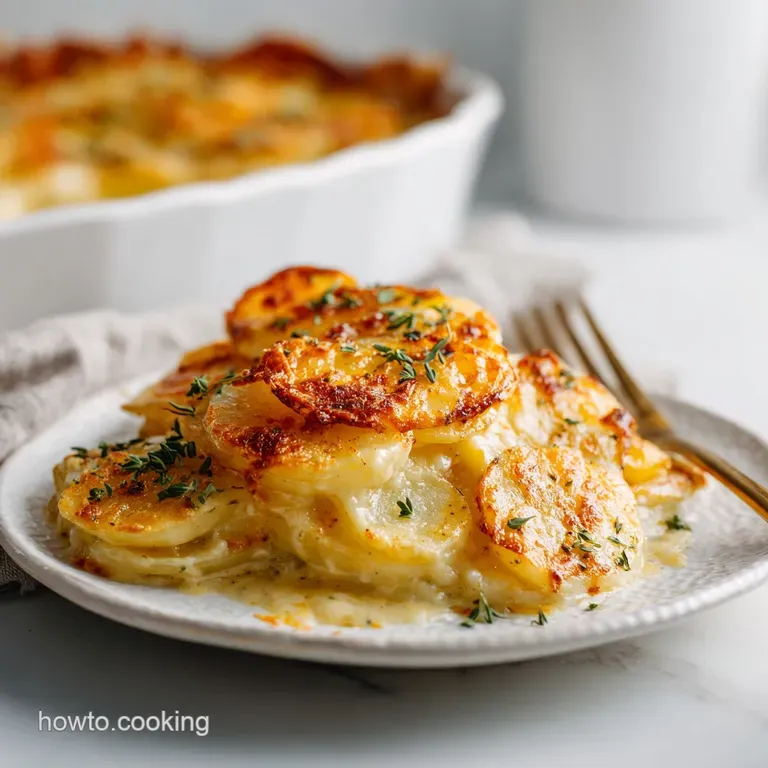
- Time: Active 20 minutes, Passive 60 minutes, Total 80 minutes
- Flavor/Texture Hook: A velvety cream sauce topped with a crust that provides a satisfying shatter.
- Perfect for: Holiday feasts, family Sunday roasts, or a budget-friendly gourmet dinner at home.
- Make Authentic Ruths Chris Gratin Potatoes
- Secrets to the Velvety Sauce
- Essential Numbers for Potato Success
- Inside the Three Cheese Blend
- Tools for a Flawless Gratin
- Step by Step to Golden Perfection
- Fixing Common Potato Problems Fast
- Smart Swaps for Every Eater
- How to Adjust the Batch
- Breaking Down Common Kitchen Myths
- Storage and Zero Waste
- Perfect Pairings for Steakhouse Spuds
- Recipe FAQs
- 📝 Recipe Card
Make Authentic Ruths Chris Gratin Potatoes
It was my brother's thirtieth birthday when I first attempted this dish. We couldn't afford a big night out at a fancy steakhouse, so I decided to bring the steakhouse to our tiny kitchen.
The air was thick with the scent of searing ribeyes, but the real star was the bubbling ceramic dish tucked in the corner of the oven. I remember the sound as I pulled it out, a soft, rhythmic sizzle that told me the cheese had finally reached that deep mahogany gold we all crave.
When we finally sat down, the room went silent. You know that specific kind of quiet that happens when everyone is too busy eating to talk? That’s what this dish does. One bite of the velvety sauce and those tender, paper thin potatoes made us forget we weren't sitting in a booth with white tablecloths.
It felt special, intentional, and entirely wholesome, even though it was just potatoes and cheese at the end of the day.
This isn't your average "dump and bake" casserole. We're talking about a method that honors the ingredients, treating the starch and the dairy with a bit of respect to get that professional finish. You won't find any watery sauce or crunchy undercooked centers here.
Instead, you'll get a consistent, rich result that feels far more expensive than the sum of its parts. Let's get into how we make this happen without breaking the bank.
Secrets to the Velvety Sauce
Getting that signature texture isn't about luck; it is about how we handle the starch and the heat. Many people struggle with their gratin separating, leaving a greasy mess at the bottom. We avoid that by building a foundation that stays together even at high temperatures.
- Starch Management: Soaking the sliced Russets for 10 minutes removes excess surface starch, which prevents the sauce from becoming unpleasantly gummy or thick.
- Roux Stabilization: Cooking the flour and butter for exactly 1-2 minutes creates a light roux that acts as a structural net, holding the milk and fats in a permanent emulsion.
- Pre Simmer Technique: Gently simmering the potatoes in the sauce before baking allows them to release just enough internal starch to naturally thicken the glaze without it breaking in the oven.
- Temperature Control: Using 375°F (190°C) provides enough heat to brown the cheese top while ensuring the internal cream doesn't boil so violently that it curdles.
| Premium Cheese | Budget Alternative | Flavor Impact | Savings |
|---|---|---|---|
| Fontina | Whole Milk Mozzarella | Less nutty, but offers the same melt and stretch | Save $3-5 |
| Aged Parmesan | Pecorino Romano | Saltier and sharper, but provides a great crust | Save $2-4 |
| Sharp White Cheddar | Yellow Sharp Cheddar | Adds color but the flavor profile remains nearly identical | Save $1-2 |
Choosing the right cheese can make or break the budget, but it doesn't have to ruin the flavor. While Fontina gives that classic buttery finish, a high-quality mozzarella mixed with a little extra black pepper can mimic that experience quite well.
The goal is to balance the meltability with a sharp kick to cut through the heavy cream.
Essential Numbers for Potato Success
Success in the kitchen often comes down to the details we can measure. For this dish, we are looking for specific visual and physical markers that tell us we are on the right track.
If you follow these checkpoints, you’ll avoid the common pitfalls of a "soupy" gratin or spuds that still have a bite to them after an hour.
First, your potato thickness is everything. We want them sliced into 0.6 cm (1/4 inch) rounds. If they are too thick, they won't soften; too thin, and they turn into mush. Second, the simmer time in the pan is a non negotiable 5-8 minutes.
You aren't trying to cook them through yet, just getting the starch to play nice with the dairy. Finally, that 10 minute rest after baking is when the magic happens. The sauce thickens as it cools slightly, turning from a liquid into a velvety coating.
| Cooking Method | Total Time | Texture | Best For |
|---|---|---|---|
| Standard Oven | 80 minutes | Deep golden crust, tender interior | Traditional steakhouse results |
| Stovetop Start | 45 minutes | Creamier, softer top | Quick weeknight family meals |
| Slow Cooker | 4 hours | Very soft, less crust development | Holiday meal prep and space saving |
Using the oven is definitely my preferred way because you just cannot replicate that oven browned crust on the stovetop. The high heat of the oven causes the proteins in the cheese to undergo a transformation that creates those savory, toasted notes.
If you're in a hurry, the stovetop method works, but you'll miss that satisfying shatter of the top layer.
Inside the Three Cheese Blend
The soul of this recipe lives in the combination of fats and flavors we use to build the base. We aren't just looking for salt; we want depth. By using three different types of cheese, we hit different parts of the palate the sharpness of cheddar, the melt of fontina, and the salty umami of parmesan.
| Ingredient | Science Role | Pro Secret |
|---|---|---|
| Russet Potatoes | High starch content | Quarter the rounds for better sauce to potato surface area |
| Half and Half | Fat to liquid ratio | Use room temp liquid to prevent the roux from clumping |
| Ground Nutmeg | Flavor enhancer | A tiny pinch bridges the gap between the dairy and the earthy potato |
Nutmeg might seem like an odd addition to a savory dish, but it's a classic French trick. It doesn't make the potatoes taste like a pumpkin pie; instead, it highlights the natural sweetness of the milk and makes the whole dish taste more "rounded." Just a quarter teaspoon is enough to make guests wonder what that secret, warming flavor is.
Tools for a Flawless Gratin
You don't need a professional kitchen to pull this off, but a few specific tools make the process much smoother. A heavy bottomed saucepan is vital for the sauce. Thin pans have hot spots that can scorch the milk or the roux, which will ruin the flavor of the entire batch.
If you have a cast iron enameled pot, that is your best friend here.
A sharp chef's knife or a mandoline is also helpful. Consistency is king. If every potato is the same thickness, every potato will be perfectly tender at the 60 minute mark. If you use a mandoline, please use the hand guard! I've had more than one "kitchen disaster" involving a mandoline and a lack of focus.
Finally,, a 9x13 inch ceramic baking dish is the ideal vessel. Ceramic holds heat more evenly than glass or metal, which helps the center of the gratin cook at the same rate as the edges.
step-by-step to Golden Perfection
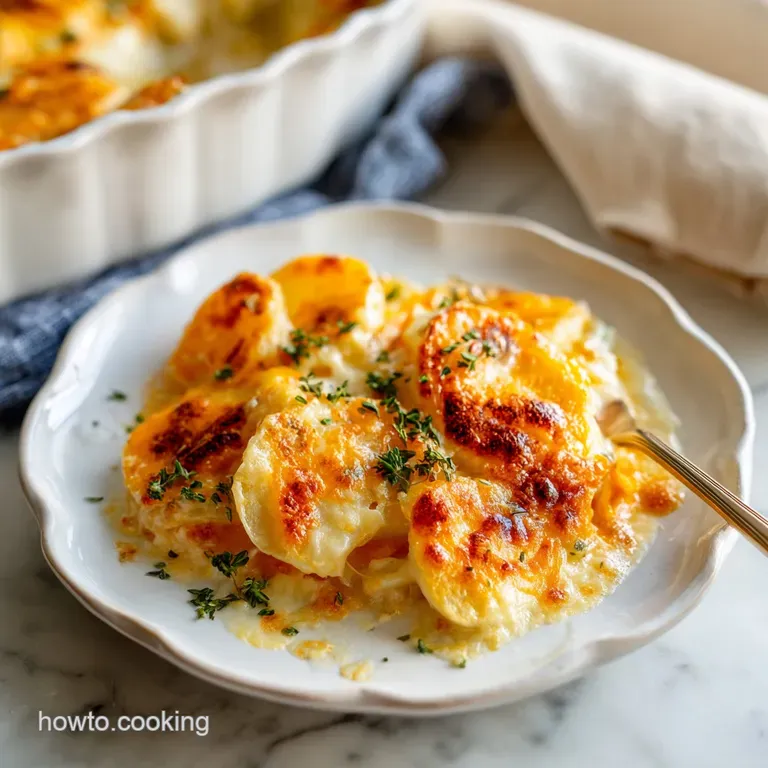
- Peel 1.1 kg (2.5 lbs) of Russet potatoes and slice into 0.6 cm rounds, then quarter them. Note: Quartering helps the potatoes stack better in the dish, ensuring no dry spots.
- Soak the potato pieces in cold water for 10 minutes. Until the water looks cloudy with released starch.
- Drain the potatoes and pat them completely dry with a clean kitchen towel. Note: Excess water will thin out your sauce and make it runny.
- Melt 45 g (3 tbsp) of butter in your saucepan over medium heat and whisk in 25 g (3 tbsp) of flour. Until it smells slightly nutty and looks like wet sand.
- Slowly whisk in 350 ml of whole milk and 235 ml of half and half. Note: Adding liquid slowly prevents lumps from forming in your roux.
- Stir in 2 cloves of minced garlic, 6 g (1 tsp) of salt, pepper, and 0.5 g (1/4 tsp) of nutmeg. Until the sauce is glossy and beginning to thicken.
- Add the dried potatoes to the sauce and simmer gently for 5-8 minutes. Until the potatoes are slightly flexible but not breaking.
- Preheat your oven to 190°C (375°F) and grease your 9x13 inch baking dish.
- Pour the potato and sauce mixture into the dish, smoothing it into an even layer.
- Mix the 115 g of cheddar and 50 g of fontina together and spread over the top, then finish with 25 g of grated parmesan.
- Bake for 60 minutes until the top is bubbling and a deep golden brown.
- Let the dish rest for 10 minutes on the counter. Until the sauce has set and no longer looks liquid when sliced.
Fixing Common Potato Problems Fast
Even the best cooks run into trouble sometimes. The most frequent issue I see is the sauce "breaking," where the fat separates from the liquid. This usually happens if the oven is too hot or if you use pre shredded cheese.
Pre shredded cheese is coated in potato starch or cellulose to prevent clumping in the bag, but that coating can prevent the cheese from melting smoothly into the sauce.
Why Your Potatoes Are Still Hard
If you pull the dish out after 60 minutes and the potatoes are still firm, it's usually because they weren't sliced thin enough or the oven temperature was uneven. Russets are sturdy, but they need that full hour to break down.
If this happens, cover the dish with foil to prevent the cheese from burning and pop it back in for another 15 minutes. The steam trapped by the foil will help soften the centers.
Why Your Sauce Is Watery
A watery sauce is often the result of not drying the potatoes well enough after soaking. Those little drops of water add up and dilute the emulsion you worked so hard to build. Another culprit could be the type of potato.
If you use waxy potatoes like Red Bliss instead of Russets, they won't release enough starch to help thicken the sauce. Stick to Russets for that classic steakhouse texture.
| Problem | Root Cause | Solution |
|---|---|---|
| Curdled Sauce | Oven temp too high or too much acid | Lower temp to 190°C and avoid adding lemon/vinegar |
| Greasy Surface | Using pre shredded cheese | Always grate your own cheese from the block |
| Bland Flavor | Not enough salt in the base | Season the sauce until it tastes slightly saltier than you think |
For a deeper dive into different potato textures, you might want to look at a proper homemade au gratin potatoes guide to see how different cheeses react. It’s all about finding that balance between fat and starch.
Common Mistakes Checklist
- ✓ Always grate your cheese fresh; the additives in bagged cheese ruin the melt.
- ✓ Don't skip the soaking step; it's the difference between velvety and gummy.
- ✓ Ensure the oven is fully preheated before the dish goes in.
- ✓ Let the gratin rest! Cutting it too soon results in a messy, runny plate.
- ✓ Use a heavy bottomed pan for the sauce to prevent a burnt, bitter aftertaste.
Smart Swaps for Every Eater
Making this for a crowd often means dealing with different dietary needs. While the classic version is quite heavy, you can make a few adjustments that won't compromise the comfort factor. For a lower calorie version, you can swap the half and half for more whole milk, though the sauce will be slightly thinner.
If you need to go gluten-free, a 1 to-1 gluten-free flour blend works perfectly for the roux.
If you are looking for something with a bit more of a nutritional punch, you can actually mix in some other vegetables. I’ve had great success adding thinly sliced parsnips or even layering in some kale. If you want a completely different flavor profile, you might enjoy checking out this Southern oven candied sweet potatoes recipe, which uses a completely different glaze technique but provides that same hearty comfort.
How to Adjust the Batch
When it comes to scaling this recipe, you have to be careful with the liquids. If you are doubling the recipe for a big party (12 servings), don't simply double the salt and spices. I find that 1.5x the salt is usually plenty.
You will also need to work in batches when simmering the potatoes in the sauce, as overcrowding the pan will make it impossible to stir without breaking the rounds.
If you are halving the recipe for a quiet dinner for two, use a smaller 20x20 cm (8x8 inch) baking dish. You should also reduce the cooking time by about 10-15 minutes, as the smaller mass will heat through faster.
When halving an egg is required in other recipes, you'd beat it and use half, but here, the measurements for the roux are straightforward enough to just cut in half directly.
Breaking Down Common Kitchen Myths
One of the biggest myths is that you must use heavy cream for a "real" gratin. In reality, the combination of whole milk, half and half, and a proper roux creates a much more stable and balanced sauce. Pure heavy cream can often feel too cloying and has a higher tendency to separate into oil.
The starch in the roux provides a "skeleton" for the sauce that cream alone lacks.
Another misconception is that you shouldn't peel the potatoes. While potato skins have nutrients, the texture of a classic Ruths Chris style dish requires that smooth, uniform bite. Leaving the skins on will interfere with the way the slices stack and prevent the sauce from fully penetrating the layers.
Save the skins for making crispy potato skin snacks later!
Storage and Zero Waste
Leftover gratin is arguably better the next day. The flavors have more time to meld, and the starch fully stabilizes. You can keep these in the fridge for up to 4 days in an airtight container. When reheating, I recommend the oven rather than the microwave.
A microwave will often make the sauce oily, while the oven at 175°C (350°F) will help restore that crispy top.
Zero Waste Tip: Don't throw away those potato peels! Toss them with a little oil, salt, and paprika, and bake them at 200°C for 15 minutes. They make an incredibly crunchy snack while your gratin is in the oven.
Also, any leftover cheese nubs that were too small to grate can be tossed into the sauce as it simmers; they will melt right in and add extra depth.
Perfect Pairings for Steakhouse Spuds
Since this dish is so rich and savory, it pairs best with proteins that have a strong sear. A classic ribeye or a peppercorn crusted filet mignon is the traditional choice, but don't overlook a simple roasted chicken. The acidity in a lemon herb chicken breast helps cut through the richness of the fontina and cheddar.
For side vegetables, think green and bright. Steamed broccoli, roasted asparagus, or a simple arugula salad with a sharp vinaigrette will balance the plate. If you want to lean into the potato theme for a holiday spread, you could even serve these alongside crispy smashed sweet potatoes for a fun contrast in textures and colors. The sweetness of the potatoes and the saltiness of the gratin make for a legendary combination.

Recipe FAQs
How to achieve the perfect sauce consistency?
Whisk your milk and half and-half slowly into the roux to form a stable emulsion. If you enjoyed mastering this creamy base, apply the same method to achieve a silky finish in our steakhouse potatoes au gratin.
Why is soaking the potatoes in cold water necessary?
Soaking removes excess surface starch to prevent the sauce from becoming gummy. Leaving starch on the slices will cause them to stick together, whereas clean, dry potatoes allow the cream sauce to coat each piece individually for a smoother texture.
Is it possible to bake these at a higher temperature to speed things up?
No, stick to the 375°F (190°C) oven setting. The 60-minute bake time is essential to allow the potatoes to become tender while the cheese topping develops a deep, golden brown crust without burning the milk solids.
How to prevent the gratin from turning out oily?
Pat the potatoes completely dry before adding them to the sauce. Excess moisture can interfere with the cream based sauce, and using freshly grated cheese rather than pre-shredded varieties ensures the cheese melts evenly without separating.
How to ensure the potatoes don't end up with dry spots?
Quarter your 1/4 inch rounds before layering them in the baking dish. Quartering the potatoes allows them to stack more compactly than whole rounds, which helps the sauce distribute evenly throughout the 9x13 dish.
Is it required to let the gratin rest before serving?
Yes, always let the dish rest for 10 minutes. This waiting period allows the sauce to thicken and stabilize, preventing the contents from sliding apart when you scoop them onto a plate.
Can I reheat leftovers in the microwave?
No, the oven is significantly better for leftovers. Reheating in a 350°F oven restores the crispy cheese topping, whereas the microwave can cause the sauce to separate and become greasy.
Ruths Chris Gratin Potatoes

Ingredients:
Instructions:
Nutrition Facts:
| Calories | 431 kcal |
|---|---|
| Protein | 16 g |
| Fat | 23 g |
| Carbs | 42 g |
| Fiber | 3 g |
| Sugar | 5 g |
| Sodium | 585 mg |
