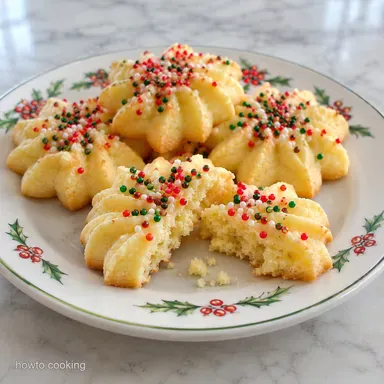
Classic Christmas Spritz Cookies with Almond

- Total1 Hr 10 Mins
- Servings40 cookies
- Calories99 kcal
- Time: 30 min active + 40 min baking
- Texture: Crisp edges with a tender center
- Serve with: A mug of hot cocoa or a cold glass of milk
Those neat, ridged edges and the little pops of color from sanding sugar make these a holiday staple. They have a snap to them that feels classic and tastes like a traditional bakery.
You get a buttery, almond-scented treat that doesn't require rolling a single piece of dough. It's a fast way to fill a cookie tin without spending hours at the counter.
Since christmas spritz cookies rely on a cookie press, the goal is a dough that's soft enough to squeeze but firm enough to hold its shape. If the dough is too warm, the cookies flatten, but if it's too cold, they won't come out of the press.
Why the Steps Matter for Christmas Spritz Cookies
The way you handle the butter and flour decides if your cookies look like stars or blobs. Creaming the butter and sugar for 2 to 3 minutes builds enough air to keep the cookies from becoming hard discs.
Stopping the mixer the moment the flour disappears is a must. If you overmix, the gluten develops and the cookies get tough instead of tender.
| Butter State | Result | Why It Happens |
|---|---|---|
| Cold | Stiff Dough | Won't push through the press disk |
| Softened | Ideal | Holds shape but flows smoothly |
| Melted | Flat Puddles | Fat leaks out too fast in the oven |
Key Numbers to Watch
Pay attention to these three markers to ensure the batch comes out right.
- Oven Temp: 375°F (190°C). A hotter oven sets the shape quickly so they don't spread.
- Spacing: 1 inch (2.5 cm). This gives them enough room to breathe without merging.
- Bake Time: 8 to 10 minutes. They should look pale on top, not brown.
What You'll Need
The ingredients here are simple, but the quality of the butter makes a difference.
- Unsalted butter (1 cup/227 g):Why this? Keeps salt levels precise
- Granulated sugar (1 cup/200 g):Why this? Provides structure and sweetness
- Large egg (50 g):Why this? Binds the dough together
- Vanilla extract (1 tsp/5 ml) and Almond extract (½ tsp/2.5 ml):Why this? Creates that classic holiday aroma
- Fine salt (¼ tsp/1.5 g):Why this? Balances the richness of the butter
- All-purpose flour (2¾ cups/345 g):Why this? Gives the cookies their shape
- Nonpareils or sanding sugar (¼ cup/50 g):Why this? Adds festive color and crunch
Necessary Press and Tools
You'll need a cookie press with decorative disks. If you don't have one, these rolled sugar cookies are a great alternative for festive shapes.
You also need:
- Baking sheets (must be completely cool)
- Hand mixer or stand mixer (like a KitchenAid)
- Wire cooling rack
- Measuring cups and spoons
The Baking Process
Step 1: Prep
Preheat the oven to 375°F (190°C) and set a rack in the center. Measure all ingredients before mixing so you don't have to stop mid-way. Check that the baking sheets are cool, flat, and completely ungreased. Use parchment only if the sheets are dark or nonstick.
Step 2: Mix the Dough
Cream the butter and sugar on medium speed for 2 to 3 minutes, until pale and fluffy. Scrape down the bowl halfway through. Add the egg, vanilla extract, and almond extract. Beat for about 30 seconds until fully combined and smooth. Add the salt and flour on low speed in 2 or 3 additions.
Stop mixing as soon as the flour disappears, about 30 to 60 seconds.

Step 3: Fill the Press and Shape
Check the texture. The dough should be soft but hold its shape when pressed between your fingers. If it is crumbly, add 1 teaspoon of cold water. If it is sticky and slumps, chill it in the refrigerator for 15 to 20 minutes.
Pack the cookie press barrel about two-thirds full, pressing the dough down firmly to remove air pockets. Attach the decorative disk. Press onto the cool, ungreased sheet, leaving 1 inch (2.5 cm) between cookies. Lift straight up with a steady motion.
If the dough stretches or pulls, chill it for a short time and try again.

Step 4: Bake
Sprinkle each cookie with nonpareils or sanding sugar right after pressing. Bake one sheet at a time for 8 to 10 minutes, until the cookies look set and the edges are just barely golden. The tops should still look pale and matte. Rotate the sheet halfway through baking if your oven heats unevenly.
Remove the cookies early if needed. A slightly soft center will firm up as it cools.

Step 5: Cool
Rest the cookies on the sheet for 1 to 2 minutes, until they set enough to lift. Move the cookies to a wire rack and cool completely, about 20 minutes, before storing or stacking. Let the baking sheet cool completely before pressing and baking the next batch. Repeat with the remaining dough in 4 batches total.
| Batch Size | Yield | Flour Needed | Butter Needed |
|---|---|---|---|
| Single | 40 cookies | 2¾ cups | 1 cup |
| Double | 80 cookies | 5½ cups | 2 cups |
Serving and Enjoying

These are best served on a large holiday platter mixed with other treats. For more variety, try these thumbprint cookies to add a jammy element to the spread.
Because they are buttery and crisp, they pair well with something acidic or bitter, like a strong coffee or a tart cranberry punch.
Make-ahead Tips
You can make the dough up to 2 days ahead. Keep it in a sealed container in the fridge. If you do this, let it sit on the counter for about 30 minutes before pressing, or it will be too stiff to push through the disk.
Baked cookies stay crisp if kept in a container with a piece of parchment paper between layers.
Flavor Tweaks to Try
Buttery dough is a great base for other flavors.
- Chocolate Version: Replace ¼ cup of the flour with cocoa powder.
- Citrus Twist: Add the zest of one lemon or orange to the sugar during the creaming step.
- Cream Cheese Swap: Replace ¼ cup of the butter with softened cream cheese for a slightly tangier, softer cookie.
- Nutty Crunch: Use almond flour for the final ½ cup of all-purpose flour for a deeper toasted flavor.
Common Beliefs
Many bakers assume parchment paper is a must for every recipe. However, for spritz cookies, a cool, ungreased metal pan is actually the better choice. A cool, ungreased metal sheet holds the dough in place while the press lifts away, so the cookies keep their shape.
Recipe FAQs
Why is the dough too stiff or too soft to push through the cookie press?
Adjust the dough by its texture: add 1 teaspoon of cold water if it crumbles, or chill it for 15 to 20 minutes if it is sticky and slumps. The dough should be soft but hold its shape when pressed between your fingers.
Pack the barrel about two-thirds full and press the dough down firmly to push out air pockets, which cause uneven pressing.
Why do the cookies stick inside the press and not release neatly?
The dough is usually too soft, so chill it for 15 to 20 minutes and try again. Press the cookies onto a cool, ungreased sheet, leaving 1 inch (2.5 cm) between them. Lift straight up with a steady motion. If the dough stretches or pulls, chill it briefly before the next press.
What makes the cookies taste flat, doughy, or not sweet enough?
Underbaking is the most common cause, so bake until the edges are just barely golden and the tops still look pale and matte. A slightly soft center is normal and firms as the cookies cool.
Sprinkle the nonpareils or sanding sugar on each cookie right after pressing, since the topping adds sweetness and crunch. Cool the cookies completely on a wire rack, about 20 minutes, before tasting.
Can almond extract be left out or swapped for vanilla?
Yes, you can leave out the almond extract, but the cookies will taste plainer. The vanilla alone carries the flavor, so the cookies still work without it. The almond extract is only a small amount, so omitting it does not affect the dough's texture or baking.
Christmas Spritz Cookies with Almond